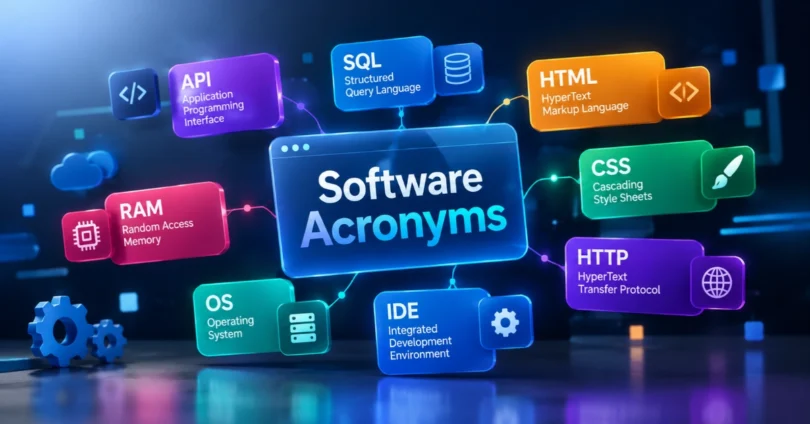
Software Acronyms, Are short forms of words commonly used in computer software and technology. They make technical terms easier to write, read and remember. These acronyms are used in software development, programming, testing and database management. Common examples include OS (Operating System), API (Application Programming Interface) and SQL (Structured Query Language). Each acronym represents a specific technical term or concept. Knowing these short forms helps readers follow software-related information more easily. This guide covers different types of Software Acronyms and their full forms.
Common Software Acronyms and Their Full Forms
Common software acronyms and their full forms are listed below.
- API: “Application Programming Interface”
- AI: “Artificial Intelligence”
- GUI: “Graphical User Interface”
- UI: “User Interface”
- UX: “User Experience”
- IDE: “Integrated Development Environment”
- SDK: “Software Development Kit”
- OS: “Operating System”
- DBMS: “Database Management System”
- SQL: “Structured Query Language”
- HTML: “HyperText Markup Language”
- CSS: “Cascading Style Sheets”
- JSON: “JavaScript Object Notation”
- HTTP: “Hypertext Transfer Protocol”
- URL: “Uniform Resource Locator”
- OOP: “Object-Oriented Programming”
- SDLC: “Software Development Life Cycle”
- QA: “Quality Assurance”
- CMS: “Content Management System”
- CRM: “Customer Relationship Management”
These acronyms are widely used in software and technology.
A to Z Software Acronyms List
Here is a short list of common software acronyms and their full forms.
- API: “Application Programming Interface”
- AI: “Artificial Intelligence”
- BIOS: “Basic Input/Output System”
- CLI: “Command-Line Interface”
- CSS: “Cascading Style Sheets”
- DBMS: “Database Management System”
- ERP: “Enterprise Resource Planning”
- FTP: “File Transfer Protocol”
- GUI: “Graphical User Interface”
- HTML: “HyperText Markup Language”
- HTTP: “Hypertext Transfer Protocol”
- IDE: “Integrated Development Environment”
- JSON: “JavaScript Object Notation”
- JVM: “Java Virtual Machine”
- KPI: “Key Performance Indicator”
- LAN: “Local Area Network”
- ML: “Machine Learning”
- NoSQL: “Not Only SQL”
- OOP: “Object-Oriented Programming”
- OS: “Operating System”
- PaaS: “Platform as a Service”
- QA: “Quality Assurance”
- RAM: “Random Access Memory”
- ROM: “Read-Only Memory”
- SDK: “Software Development Kit”
- SQL: “Structured Query Language”
- TCP: “Transmission Control Protocol”
- UI: “User Interface”
- URL: “Uniform Resource Locator”
- UX: “User Experience”
- VPN: “Virtual Private Network”
- WAN: “Wide Area Network”
- XML: “Extensible Markup Language”
- YAML: “YAML Ain’t Markup Language”
- ZIP: “Zone Information Protocol”
These acronyms represent common terms used in software and technology.
Programming Software Acronyms
These acronyms are related to programming tools and techniques.
- IDE: “Integrated Development Environment”
- SDK: “Software Development Kit”
- API: “Application Programming Interface”
- OOP: “Object-Oriented Programming”
- AST: “Abstract Syntax Tree”
- REPL: “Read-Eval-Print Loop”
- JDK: “Java Development Kit”
These acronyms are useful in programming.
Software Development Acronyms
These acronyms describe common software development methods.
- SDLC: “Software Development Life Cycle”
- CI: “Continuous Integration”
- CD: “Continuous Delivery”
- TDD: “Test-Driven Development”
- BDD: “Behavior-Driven Development”
- MVP: “Minimum Viable Product”
- RAD: “Rapid Application Development”
These acronyms are common in software development.
Software Testing Acronyms
These acronyms are used in software testing and quality checks.
- QA: “Quality Assurance”
- QC: “Quality Control”
- UAT: “User Acceptance Testing”
- SIT: “System Integration Testing”
- E2E: “End-to-End Testing”
- A/B: “A/B Testing”
- SUT: “System Under Test”
These acronyms describe common software testing terms.
Database Software Acronyms
These acronyms relate to database systems and data management.
- DBMS: “Database Management System”
- RDBMS: “Relational Database Management System”
- SQL: “Structured Query Language”
- CRUD: “Create, Read, Update and Delete”
- ETL: “Extract, Transform and Load”
- NoSQL: “Not Only SQL”
- OLAP: “Online Analytical Processing”
These acronyms are important in database software.
Operating System Acronyms
These acronyms relate to operating systems and their functions.
- OS: “Operating System”
- RTOS: “Real-Time Operating System”
- GUI: “Graphical User Interface”
- CLI: “Command-Line Interface”
- IPC: “Inter-Process Communication”
- HAL: “Hardware Abstraction Layer”
- POSIX: “Portable Operating System Interface”
These acronyms are widely used in operating systems.
Web Development Software Acronyms
These acronyms are commonly used in web development.
- HTML: “HyperText Markup Language”
- CSS: “Cascading Style Sheets”
- DOM: “Document Object Model”
- URL: “Uniform Resource Locator”
- HTTP: “Hypertext Transfer Protocol”
- JSON: “JavaScript Object Notation”
- XML: “Extensible Markup Language”
These acronyms are essential web development terms.
Mobile App Development Acronyms
These acronyms relate to mobile application development.
- APK: “Android Package”
- AAB: “Android App Bundle”
- PWA: “Progressive Web App”
- OTA: “Over-the-Air”
- IAP: “In-App Purchase”
- SDK: “Software Development Kit”
- UI: “User Interface”
These acronyms are commonly used in mobile app development.
Cybersecurity Software Acronyms
These acronyms relate to software security and digital protection.
- MFA: “Multi-Factor Authentication”
- 2FA: “Two-Factor Authentication”
- IAM: “Identity and Access Management”
- SSO: “Single Sign-On”
- EDR: “Endpoint Detection and Response”
- IDS: “Intrusion Detection System”
- VPN: “Virtual Private Network”
These acronyms are important in cybersecurity.
Cloud Software Acronyms
These acronyms describe common cloud computing services.
- SaaS: “Software as a Service”
- PaaS: “Platform as a Service”
- IaaS: “Infrastructure as a Service”
- FaaS: “Function as a Service”
- CDN: “Content Delivery Network”
- VM: “Virtual Machine”
- API: “Application Programming Interface”
These acronyms are widely used in cloud software.
Artificial Intelligence Software Acronyms
These acronyms relate to artificial intelligence technologies.
- AI: “Artificial Intelligence”
- ML: “Machine Learning”
- NLP: “Natural Language Processing”
- LLM: “Large Language Model”
- RAG: “Retrieval-Augmented Generation”
- CNN: “Convolutional Neural Network”
- GAN: “Generative Adversarial Network”
These acronyms represent important AI technologies.
Common FAQs About Software Acronyms
Here are some FAQs of Software Acronyms:
How can software acronyms help beginners?
Software acronyms help beginners recognize technical terms used in programming, applications and computer systems. They also make technical information easier to read.
What are the most useful acronyms for software developers?
Developers often use IDE (Integrated Development Environment), SDK (Software Development Kit) and API (Application Programming Interface) when creating and managing software projects.
What does IDE mean in software development?
IDE stands for Integrated Development Environment. It is a tool that combines features such as a code editor, debugging tools and build functions in one place.
What is the full form of SDK?
SDK stands for Software Development Kit. It provides tools, libraries and resources that developers use to create applications for specific platforms.
What does GUI stand for in software?
GUI means Graphical User Interface. It allows users to interact with software through visual elements such as buttons, icons, menus and windows.
What is the meaning of CLI in software?
CLI stands for Command-Line Interface. It lets users control software by typing commands instead of selecting options through graphical menus.
What does CMS mean in software?
CMS stands for Content Management System. It helps users create, edit, organize and publish digital content on websites without needing to write all the code manually.
What does ERP stand for in business software?
ERP means Enterprise Resource Planning. It connects business activities such as finance, inventory, purchasing and human resources through an integrated software system.
Conclusion
Software Acronyms make technical terms shorter and easier to use in the world of technology. They are commonly used in programming, software development, database management and business applications. Knowing their full forms helps readers recognize important software concepts and follow technical information more easily. From IDE and SDK to GUI and ERP, each acronym has a specific meaning and purpose. Learning common Software Acronyms can improve technical knowledge and make software-related communication clearer.